The Daily Standard
Story Archive

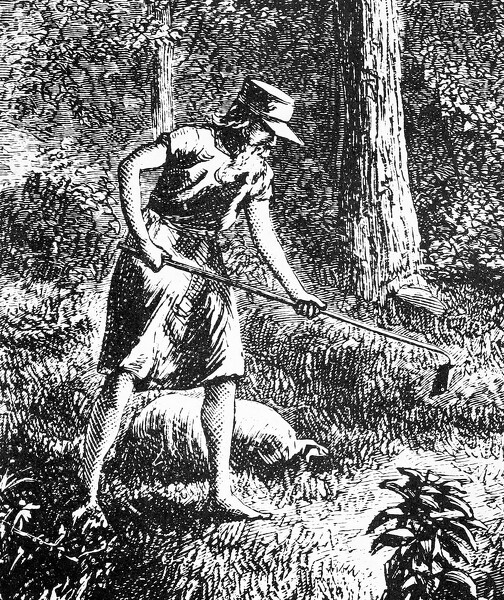
John Chapman, aka Johnny Appleseed, (1774-1845) was an evangelist and planter who traveled throughout the Midwest and is buried in Fort Wayne. This illustration of Chapman is an etching from Harper's New Monthly Magazine in 1871.
ROCKFORD - About 20 people attended an appealing presentation in Rockford Monday night about John Chapman, the legendary American orchardist better known as "Johnny Appleseed."
Chapman, who famously introduced apple trees from apple seeds across Pennsylvania, Ohio, Indiana, Illinois and some of West Virginia, walked the grounds of what was then Shanesville, now known as Rockford, Shanes Crossing Historical Society president Mike Schumm said during his talk titled, "Johnny Appleseed: The Man, the Myth and his Local Influence."
On April 29, 1828, Chapman leased 3 acres north and west of Shanesville from William Botts Hedges, according to a historical marker at 109 W. Bridge St.
"He paid Hedges by cultivating 1,000 apple trees on the site over the next 10 years," the marker reads. "The Hedges Nursery profited the Shanesville area by shipping apples to the major trading posts at Piqua and Fort Wayne. During his lifetime, Chapman proved an able businessman who established profitable orchards in Ohio, Pennsylvania and Indiana."
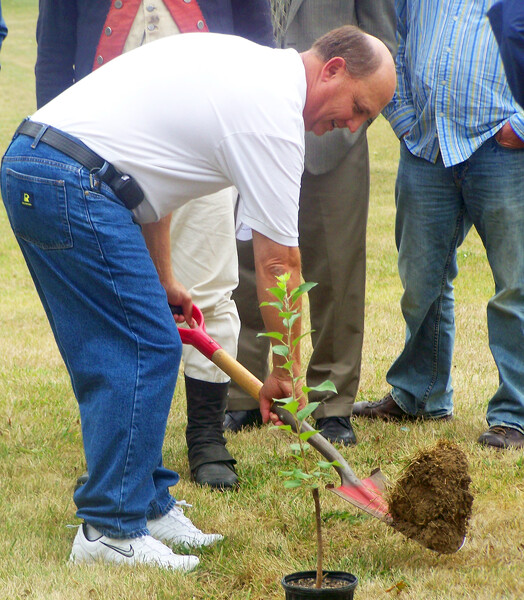
Mike Schumm plants a new apple tree on his property in 2009.
In 2009, American Forests, the Johnny Appleseed Foundation, the Museum at Urbana University and the Village of Rockford planted two "Rambo" apple trees at the Hedges Nursery site on Schumm's property off U.S. Route 33.
The Rambo is an apple variety with roots tracing back to 17th-century colonial America. The tree on Schumm's property is from a cutting of the last remaining tree Chapman
planted in Nova.
"They called from the American Forestry Service and the Johnny Appleseed Society and asked if they could plant a tree on our property," Schumm said. "We planted two that day; one's gone now. That was a pretty special moment. They asked us if they could go back each year and plant another tree and make another nursery and my wife said, 'Absolutely not.' She said apples are dirty."
Chapman was born in Massachusetts in 1774 and left home about 20 years later to tend to apple orchards in western Pennsylvania, Schumm said.
Chapman noticed the German cider mills, gathered the leftover apple seeds from the cider mills' pumice stones and sold them to settlers.
"He became what we call an orchardist," he said. "When he heard about people moving westward, he was one who couldn't settle down, so he had a lot of different orchards or nurseries to take care of."
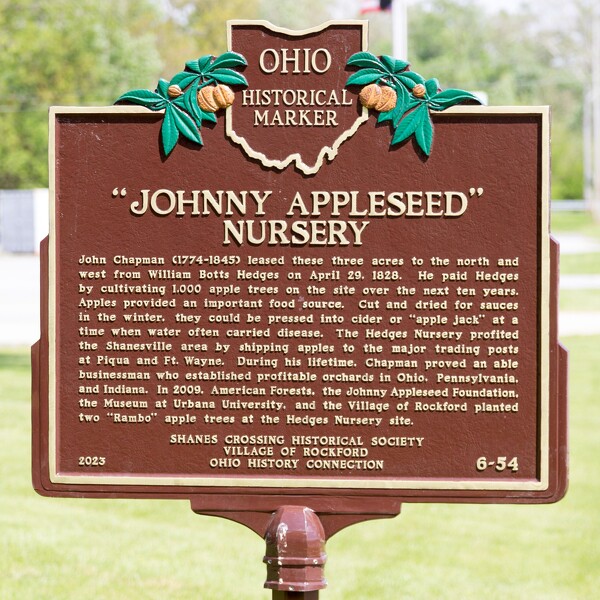
A historical marker, located at 109 W. Bridge St., Rockford, explains John Chapman's local influence.
The marker reads:
"Johnny Appleseed" Nursery
John Chapman (1774-1845) leased these three acres to the north and west from William Botts Hedges on April 29, 1828. He paid Hedges by cultivating 1,000 apple trees on the site over the next ten years. Apples provided an important food source. Cut and dried for sauces in the winter, they could be pressed into cider or "apple jack" at a time when water often carried disease. The Hedges Nursery profited the Shanesville area by shipping apples to the major trading posts at Piqua and Ft. Wayne. During his lifetime, Chapman proved an able businessman who established profitable orchards in Ohio, Pennsylvania, and Indiana. In 2009, American Forests, the Johnny Appleseed Foundation, the Museum at Urbana University, and the Village of Rockford planted two "Rambo" apple trees at the Hedges Nursery site.
"Chapman set out in 1802 with a canoe full of seeds to sell to pioneers trying to settle the Wild West," according to information from the Heinz History Center, a museum in Pittsburgh. "Although it seemed like a great way to make money, he didn't profit much from the sales. Chapman often traded for the seeds, and when he did take money, it was typically a small amount. It's said that he planted saplings along his routes for settlers to start their own orchards."
The apples Chapman planted and sold were grown from seed, instead of grafting, resulting in bitter, tart apples that were used to make hard cider and applejack, an apple brandy.
Because water was often contaminated in that era, the alcohol became a safer alternative.
Chapman planted hundreds of thousands of trees, but most of them were destroyed during Prohibition when the government cut down the trees to prevent people from making cider.
Schumm said Chapman walked 4,000-5,000 miles in his lifetime; most if not all of those miles were barefoot. His soles were so calloused he could walk on hot coals or stick a needle in them, entertaining children. He would sometimes walk 15 miles a day, Schumm said.
Chapman was a vegetarian and a devout Catholic who frequently read passages aloud.
He never married and died in 1845 from pneumonia. He is buried in an unmarked grave in Fort Wayne. A memorial marker features Chapman's name and the phrase, "He lived for others."
"I think that's so meaningful because he did," Schumm said. "If you stop and think about it, he just lived for other people, planting apple trees."
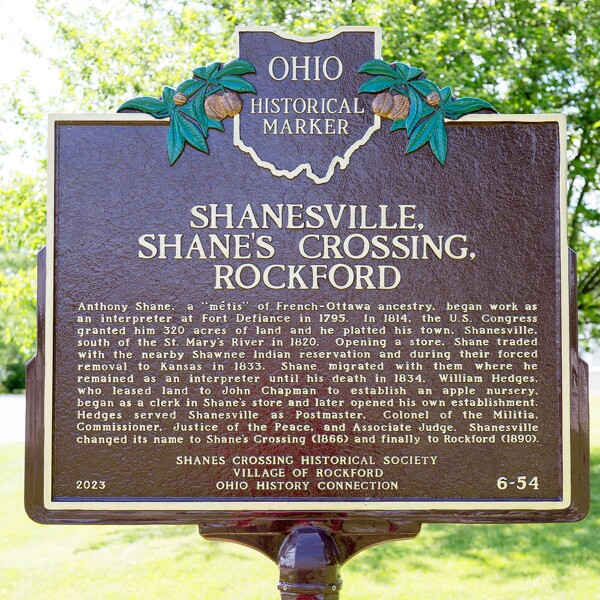
A historical marker, located at 109 W. Bridge St., Rockford, explains John Chapman's local influence.
The reads reads:
Shanesville,
Shanes Crossing.
Rockford
Anthony Shane, a "métis" of French-Ottawa ancestry, began work as an interpreter at Fort Defiance in 1795. In 1814, the U.S. Congress granted him 320 acres of land and he platted his town, Shanesville, south of the St. Mary's River in 1820. Opening a store, Shane traded with the nearby Shawnee Indian reservation and during their forced removal to Kansas in 1833, Shane migrated with them where he remained as an interpreter until his death in 1834. William Hedges, who leased land to John Chapman to establish an apple nursery, began as a clerk in Shane's store and later opened his own establishment. Hedges served Shanesville as Postmaster, Colonel of the Militia, Commissioner, Justice of the Peace, and Associate Judge. Shanesville changed its name to Shane's Crossing (1866) and finally to Rockford (1890).