The Daily Standard
Story Archive

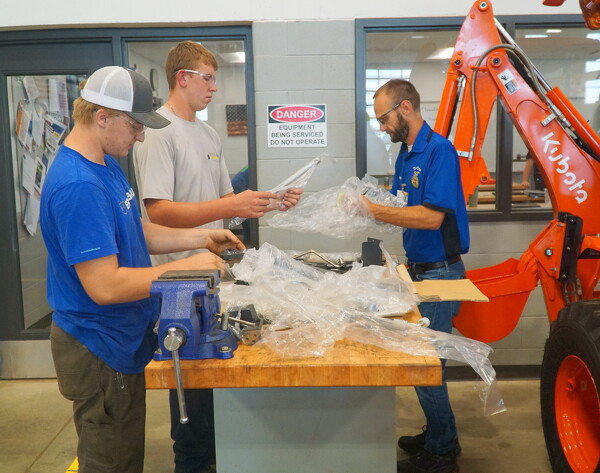
Tri Star Career Compact's agricultural industrial technology instructor Ken Platfoot, far right, leads St. Henry seniors Gavin Hess and Carson Schmackers in hydraulic training next to a Kubota diesel tractor loader backhoe.
CELINA - Tri Star Career Compact's agricultural industrial technology program is now a certified Kubota Tech program, offering students access to Kubota equipment and engines valued at hundreds of thousands of dollars, and providing a curriculum designed to prepare them for a career in the off-road diesel equipment industry.
The program prepares students to inspect, service, diagnose and repair Kubota equipment, but those skills can be applied to other manufacturers' equipment as well, according to agricultural industrial technology instructor Ken Platfoot.
"(We're) one of five in the entire country - the only one in Ohio," Tri Star director Tim Buschur said about certified high school Kubota Tech programs. "So we're the only (high) school in Ohio that can teach this training to these kids."
Perhaps most importantly, Platfoot's students are receiving hands-on training on the type of equipment they'll encounter in the workplace.
"When I looked through what they had to offer, it's exactly what I've been looking for through eight years of teaching and trying to figure out 'How do we get newer engines? How do we get new equipment to work on?'" Platfoot said. "Because our program doesn't have very many training aids, because the program's based off of what the students bring in and sometimes community members, and a lot of times we get older things that they're not really going to necessarily work on at the dealership. So now we're getting brand new things, brand new pieces of equipment every year to work on."
The Kubota Tech program was initially designed for colleges, Platfoot said, adding that the Ohio State University Wooster Campus and the Tennessee College of Applied Technology (TCAT) helped develop the Kubota Tech curriculum.
"The Kubota Tech was developed for colleges. So they just started introducing into high schools," Platfoot said. "They'll come in and actually meet with the high school, and it has to meet certain criteria. They go through our curriculum. They go through our facility. They meet with us multiple times to even see if we'll qualify for it."
Platfoot said he was also evaluated by Kubota officials.
"They met with administration. They met with me. They met with students," he said. "They actually observed me teaching a class and seeing how I taught the class, whether it was in the classroom or in the lab, seeing how the day-to-day operations went, and then they decided after if they would even allow me to pursue (certification)."
In the end, Tri Star was given the go-ahead, and Platfoot underwent weeklong training sessions at various locations, including the Ohio State University Wooster Campus and TCAT, in pre-delivery inspection and assembly, preventative maintenance inspection, maintenance procedures, electrical, hydraulics, engine, powertrain, and breaks, steering, and suspension.
"It's eight certifications that I had to go through the training on to be able to implement the training to the students, and now the students have access to be able to perform all eight of those certifications, which consist of classroom lectures, hands-on labs and passing a certification test."
Platfoot said he tailored the Kubota Tech program curriculum to the overall needs of his classroom.
"It has not replaced (the classroom curriculum), it actually works right with it. So when I reviewed the curriculum to see if it even was something we could use in here, it jives directly with the state curriculum and the curriculum that I already was teaching," he noted. "It actually meshes perfectly. It was almost scary how much. We were already teaching most of the things, but now we're able to implement Kubota's curriculum and use their equipment that they put us on a rotation (for)."
Each year, Kubota will provide various pieces of equipment to Tri Star on a rotating basis. Tri Star must then return them fully intact before receiving a new batch of equipment.
"What's nice is the students aren't taking it apart and putting it together a thousand times and then it's wore down to nothing, because we're on an annual rotation," Platfoot pointed out. "So that's huge being able to get new in every year. You get to see new, get to touch new, get to experiment with new equipment versus old stuff."
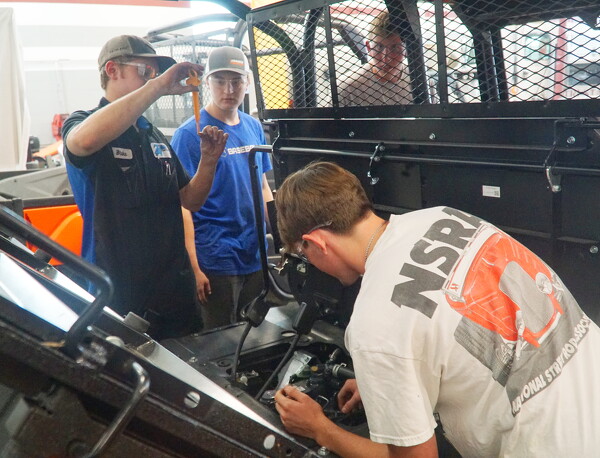
Tri Star students work on a Kubota side by side on Wednesday afternoon. Agricultural industrial technology at Tri Star is now a certified Kubota Tech program.
This year the company has furnished Tri Star with a diesel zero-turn mower, a diesel tractor loader backhoe, a diesel side by side and a gas utility vehicle.
Students will work on the vehicles throughout the school year.
"They'll run through all those procedures from engines to brakes, steering, suspension," Platfoot said. "They will tear components apart. They will do inspections. They will do measurements. They'll do reassembly. They'll actually change fluid and filters in this new equipment, get experience with that."
On top of that, Kubota has donated roughly 20 engines that would each cost about $15,000 new, according to Platfoot.
"These were all warranty engines, so they came in with warranty issues … which is great, because now the students have to take them apart and tell me what was wrong with them, and Kubota's provided me access - because we have the serial numbers - of the repair history. So I know what they found and turned in as a claim, so the students have to find that as they're tearing the engines down."
Tearing down engines is a major classroom requirement for juniors.
"We're two weeks in and they're starting engine teardown. So it's getting them to do a complete engine teardown," Platfoot said. "While we're doing that, they're learning more about tools, fasteners, torquing fasteners, engine components and engine operations. So they're learning all that while actively tearing them down."
In previous years, the shop was filled with a hodgepodge of engines, Platfoot said.
"Some were when I took the class 20 years ago, so there weren't many good pieces left of these engines. There weren't parts with them. We didn't have manuals for them," he said. "Now the students all have the same engines. We have manuals. We have spare parts. It's much more organized."
Students who perform well in the agricultural industrial technology program can benefit greatly from the Kubota Tech program.
"If the student passes all eight certifications I can enroll them in Kubota University, which is an online course," Platfoot said. "They can actually graduate here as a Level 1 Kubota technician before they leave."
Though Platfoot greatly appreciates the partnership with Kubota University, he stressed that Tri Star hasn't signed any kind of exclusive deal with the company and is open to receiving donated vehicles and engines of all kinds.
"I didn't take this on to just be committed to just Kubota. I love what they're doing, love everything about it," Platfoot said. "I would love to have (more colors than just Kubota orange represented), with the still guided curriculum following each manufacturer's workshop manuals and how the students can just learn from that. Because some really want to work on certain manufacturers' (equipment)."