The Daily Standard
Story Archive

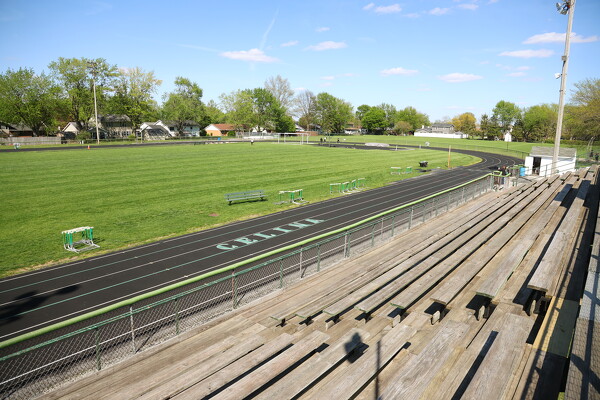
Plans under discussion for the new East Campus include a new football field inside a new track.
CELINA - School board members are leaning in the direction of synthetic turf for a new football field and asphalt base for the new track facility, rather than post-tension concrete.
At Monday night's regular meeting, board members took up the discussion at the behest of Superintendent Brooke Gessler. Though they didn't take a formal vote, all five board members supported the preliminary notion of opting for synthetic turf and asphalt base for the new track and field/football facility to go up on the East Campus of the new grades 7-12 building, a project that could be completed as soon as the next 2 ½ years, according to board member Mark Huelsman.
"One of the reasons why this is important that we start having these conversations is because the infrastructure, there's a timeline, by which Garmann Miller and construction, that they need to have in place, so they know what it looks like as far as the infrastructure," Gessler said.
The total cost for Phase 1 of the master facility plan, which would among other things calls for the construction of a new track and field/football stadium, is pegged at $1.5 million. Going with synthetic turf would add on $988,334, and upgrading the track base with post-tensioned concrete another $554,212, together amounting to $1.55 million.
A synthetic turf field would have to be replaced every 10 to 12 years but wouldn't necessitate watering, marking, striping, mowing and the other maintenance associated with a grass field.
Board president Adam Schleucher led the charge for synthetic turf and was able to rally his colleagues around the option despite some initial reservations expressed in regard to the increased likelihood of athletic injuries.
Gessler, too, backed the option of synthetic turf from the perspectives of enhanced functionality beyond the gridiron, as well as the boon it could deliver to Celina when the school is able to host tournament games.
"Outside of football, there are other opportunities for us to utilize this space. You could have more youth programs utilize this space," she said. "We would be able to potentially host some community events like if we wanted to do reading-under-the-lights one night and … invite families and kids and put books into their hands for early literacy."
There's also the economic benefits to consider, such as the revenue generated from being able to host tournament games because of the synthetic turf.
"When you host tournaments, you have groups that get the revenue from the concessions, you can charge parking, and then you also bring people from the outside into the community, and they're going to eat here …. and they may even look for VRBOs to stay," Gessler pointed out.
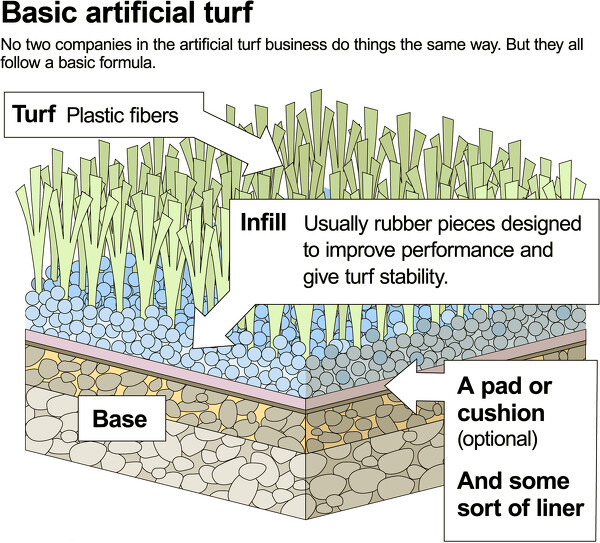
Basic artificial turf: No two companies in the artificial turf business do things the same way. But they all follow a basic formula.
Board member Julie Sommer raised the specter of athletic injuries with an artificial turf field.
"I know there's been studies done about the safety," she said, calling for the need for more research to show "what really is best for kids."
Schleucher sought to ease some of Sommer's concerns, pointing to a conversation he had with the representative of an unspecified turf company at a trade show in Columbus who reportedly asserted that comparing NFL football fields to high school football fields is not apples to apples.
"They said the big difference is the NFL has 30 to 40 staff members that all they do is take care of that sod field, and they said most high schools have a part-time guy, maybe two part-time people that take care of it," he said. "So to compare the injuries from one to the other isn't a good comparison."
Furthermore, the company representative said that many schools that shy away from sod fields go with a multipurpose turf rather than a specific football turf or soccer turf.
"It's not good for football and it's not good for soccer, but it's a hybrid that you could play both on. And they said that that's where there's a lot of issues," Schleucher said. ""Their recommendation (is) … if you were to go with turf and you're going to play football on it, put football turf down and not try to do a multipurpose (turf). Because then that also eliminates some of those injuries."
Board members Carl Huber and Jon Clouse both voiced a fondness for natural grass. Yet they were willing to look at the benefits of synthetic turf.
"I've always been a fan of grass," Huber said. "But I also see the advantage of having turf … of not having to worry about rainouts, of not having to worry about torn-up dirt, not having to worry about sprinklers accidentally springing a leak and flooding out the whole field."
Still, Huber mentioned his worries about turf injuries.
"I've seen them happen, but those were on those multi-use turfs," he said, recommending that if the board does decide to go with turf, to opt for football turf for the football field and soccer turf for the soccer field.
Clouse displayed a willingness to go with synthetic turf.
"I'm an old-school football coach, and I liked grass, I like the thing about mud, dirt. I like that sort of thing. That's just part of the game," he said. "But I'm completely open-minded with the turf. I think it's OK. I really appreciate hearing that you want to go with something that will be safer for the football players. It's actually a football turf. I think that's great."
As to the track, board members just didn't see the value in upgrading the track base with post-tensioned concrete to the tune of nearly $555,000. That kind of money would be better spent down the road actually upgrading the asphalt surface on which the athletes run, Huber pointed out.
In the end, board members informally but unanimously gave their tentative blessing to synthetic turf and no upgrades to the track base.
Back in December, board members established their athletic facility priorities for the grades 7-12 East Campus, giving direction to civic organizations looking to launch fundraising campaigns.
After discussion, the buttoning-up of the Fieldhouse and the Tri Star building for new purposes, followed by a new track, and then ground infrastructure that paves the way for a potential football field within the new track were laid out as the top priorities.
The goal of a master plan, Matt Hibner, Garmann Miller's director of architecture, stressed, is to set the direction for the long-term facility needs and wants of the district.
"We're continuing to build this master plan as a road map for decisions that are needed along the way," he said.
Board members in March 2025 voted to spare the iconic but outdated Fieldhouse from demolition to make use of its locker rooms and other amenities, yet emphasized that high school basketball games will be played in a new gymnasium once the grades 7-12 school building is completed.