
The Daily Standard
Story Archive

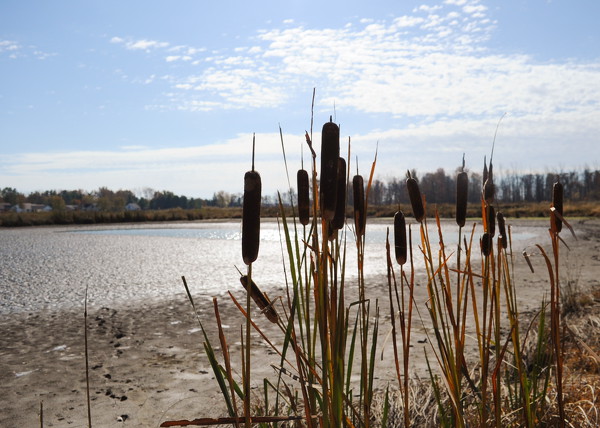
Officials continue to pursue building treatment trains and wetlands to improve local water quality.
CELINA - Algal microcystin toxin levels in Grand Lake last week were a third of what they were a decade ago and below the recreational advisory threshold set by the World Health Organization (WHO), yet still exceeded Ohio's limit, attendees learned at Lake Improvement Association's Saturday morning meeting.
Much of that substantial drop can be credited to wetlands and treatment trains, vegetative biofilters which remove nutrients from the water flowing from the creeks into the lake, according to Stephen Jacquemin, an environmental sciences professor at Wright State University-Lake Campus.
They're a key component of a long-term plan to stop toxic blue-green algal blooms from growing in Grand Lake. The phosphorus-fueled blooms have resulted in state-issued water advisories on the lake every year since 2009.
Nutrient runoff comes from many sources, but in the Grand Lake Watershed, studies show it's mostly from farmland in the 58,000-acre, livestock-heavy watershed.
This is typically the time of the year when algal biomass is on the rise. But Grand Lake, at least at this point in time, is holding steady.
"Our biomass is down compared to what it would be or what we'd expect to see in past years," Jacquemin said. "It's not like the lake is crystal clear right now, but the level of algae is lower than it historically has been."
Consequently, harmful microcystin toxins are down. Microcystin is produced by cyanobacteria, more commonly called blue-green algae, that can sicken people and animals.
Elevated microcystin toxins can cause skin rashes, respiratory and gastrointestinal distress and harm the liver, Ohio EPA officials have said.
The local watershed is the only in the state designated as distressed due to unsafe algal toxin levels, a designation the watershed received in January 2011 after animals and humans were sickened by the toxins in 2010.
Last week, total microcystin toxin levels in Grand Lake registered at about 16 micrograms per liter. WHO sets it recreational advisory threshold at 24 micrograms per liter and the Ohio Department of Natural Resources at 8 micrograms per liter, according to Jacquemin's presentation.
"We're sitting at about a third of what you would expect toxin level by looking at the same time over the last 10 years," he said. "We're doing OK, we're doing well."
Since 2012, treatment trains have been constructed on Prairie Creek, Coldwater Creek, Beaver Creek, and, most recently, the Big Chickasaw Creek, all tributaries that flow into the lake. Treatment trains divert a portion of the creeks' water into a series of wetland cells containing plants that remove some nutrients before the cleaner water is released into the lake.
"They all help to take down the nutrients, they all help to sort of quell the algae in the lake," Jacquemin said. "Every bit of nutrients that gets pulled away from that system, the better."
Over the last five years, treatment trains have captured more than 50,000 pounds of nitrate, 220 tons of sediment and about 6,000 pounds of total phosphorus, with about half of that heap being dissolved-reactive, Mercer County Agriculture and Natural Resource Director Theresa Dirksen said early this year.
They're once again pulling their weight in 2024, removing anywhere from 60 to 75% of phosphorus, nitrate and sediment from water inflow.
"Our wetlands continue to pump, they continue to operate extremely effectively," Jacquemin said.
The Prairie Creek Treatment Train is moving about a million gallons a day and the Beaver Creek about 750,000 gallons a day, Jacquemin pointed out.
After last year's pump repairs, the Coldwater Creek Treatment Train is gradually ramping up, filtering over 3 million gallons a day.
A wetland and stream restoration project involving the Big Chickasaw Creek and the Little Chickasaw Creek was completed earlier this year.
"We really didn't expect this site to do much this year because it's a brand new site. We just got done moving earth. It was just planted back in May," Jacquemin said. "For a brand new wetland, there's typically a sort of need to just keep watering them, keep it wet, but not really an opportunity to move that much water."
To everyone's surprise, Jacquemin said the site is moving about half a million gallons a day, seemingly operating a year ahead of schedule. Next year that rate is expected to double.
"This is the name of the game, right?" Jacquemin said. "Water quality issues manifesting as algae, algae is fueled by nutrients. So take the fuel out and that's that - and that's the biggest thing that these wetlands can kind of bring to the table."
Pumps are situated in the Big Chickasaw channel.
"This particular location allows us to grab flows from Big Chickasaw Creek or - when Big Chickasaw Creek is not flowing that much - it is positioned so that the site can grab lake backwater," he said.
The water flows in via a couple pumps to an initial 6-to-8-foot-deep settling pool where big particles of sediment and nutrients sink to the bottom. Its next destination is a big, meandering marsh which is only 6 to 12 inches deep.
"Then that water flows out via the outflow and then that outflow water kind of percolates through the forrest and then ends up in the Big Chickasaw littoral region," he said.
In addition to improving water quality, wetlands, treatment trains and similar conservation efforts increase habitat diversity for wildlife. "The Big Chickasaw littoral area this year has garnered some really positive feedback. There's a lot of great vegetation out there that we haven't seen in a long time," Jacquemin said. "A lot of beautiful, beautiful lily pads have started to take off."