Monday, March 27th, 2023
Rocks of Ages
Experts used rocks and fossils to tell future geologists about prehistoric times
By Daily Standard Staff
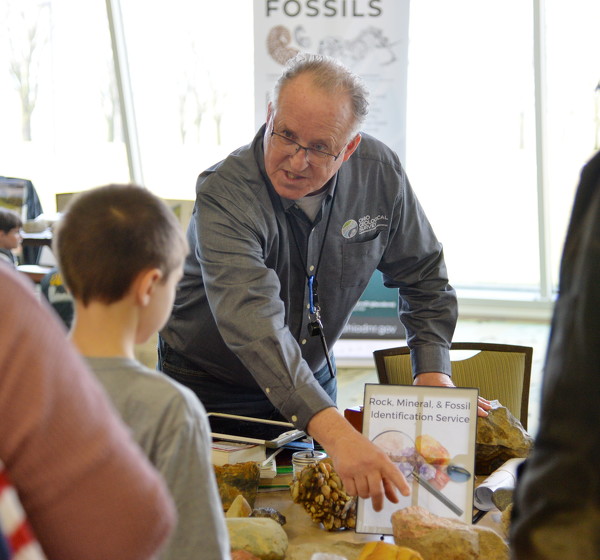
Photo by Paige Sutter/The Daily Standard
Geologist Frank Fugitt talks to a group about rocks, minerals and fossils during Ohio Geology Discovery Day at Wright State University-Lake Campus on Saturday afternoon.
CELINA - Budding earth scientists learned how much geology rocks during Ohio Geology Discovery Day at Wright State University-Lake Campus on Saturday.
Molly Hunt, a geologist and paleontologist with the Ohio Department of Natural Resources' Division of Geological Survey, spoke about Ohio's geology throughout the Paleozoic era. Beginning 541 million years ago, life during this time was primitive and included invertebrates and the earliest forms of fish and amphibians, she said.
Ohio was located near the equator and mostly under water 485.4 million years ago, Hunt said. Fossils from corral reefs, which thrive near the equator, have been found in the state, she said. Most creatures at the time were invertebrates, or animals without bones.
The state fossil fish, the Dunkleosteus Terrelli, existed during the Devonian period 419 million years ago, Hunt said. The fish was about 29 feet long and bigger than a school bus, she said. Although it didn't have teeth, the fish could cut its prey with the sharpness of its jawbone.
"It was actually eating sharks," Hunt said.
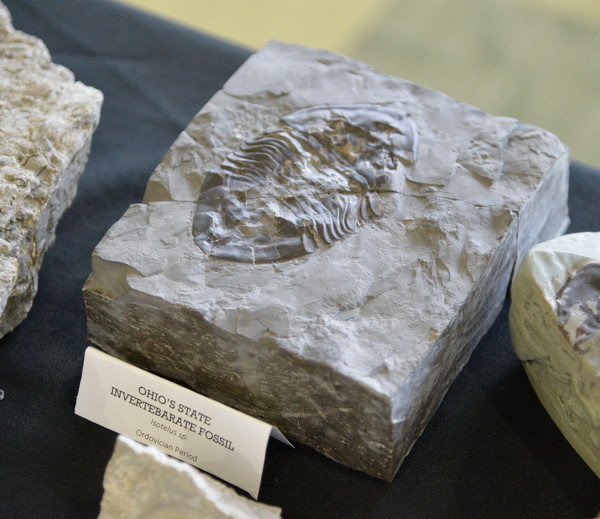
Photo by Paige Sutter/The Daily Standard
There were several ancient fossils on display at Ohio Geology Discovery Day at Wright State University-Lake Campus on Saturday afternoon.
By the early Carboniferous period 359 million years ago, Ohio began to dry out and mountains continued to form. Much of the planet's coal was created during this period due to the earth's swampy conditions.
"The (late Carboniferous period) is especially important in Ohio, because it's where we get coal," Hunt said.
Ohio was still near the equator and boasted a coastal swamp by the Permian period 299 million years ago, she said. Creatures included the eryops, an amphibian that looks similar to a crocodile, as well snails and clams.
Hunt said the largest mass extinction of life on the planet occurred at the end of the Permian period, which killed 94% of all living creatures 252 million years ago.
Evidence suggests that massive volcanic eruptions, one or more meteor impacts, and/or a rapid temperature increase due to a sudden release of methane from the ocean bottoms may have contributed to this extinction, according to the U.S. Geological Survey.
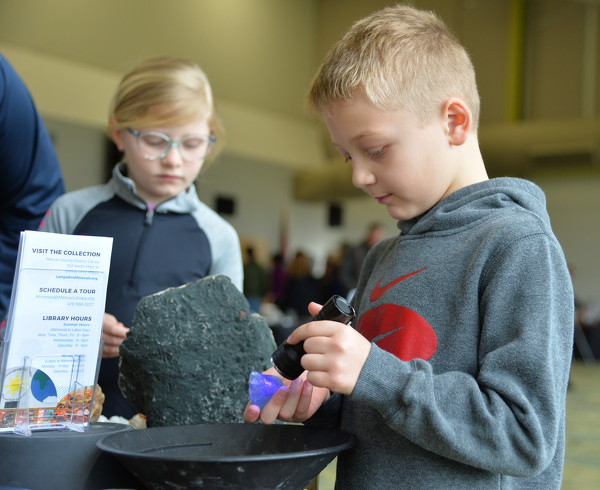
Photo by Paige Sutter/The Daily Standard
Xavier Rentz, 7, Minster, shines a light on a piece of fluorite and watches it glow during Ohio Geology Discovery Day at Wright State University-Lake Campus on Saturday afternoon.
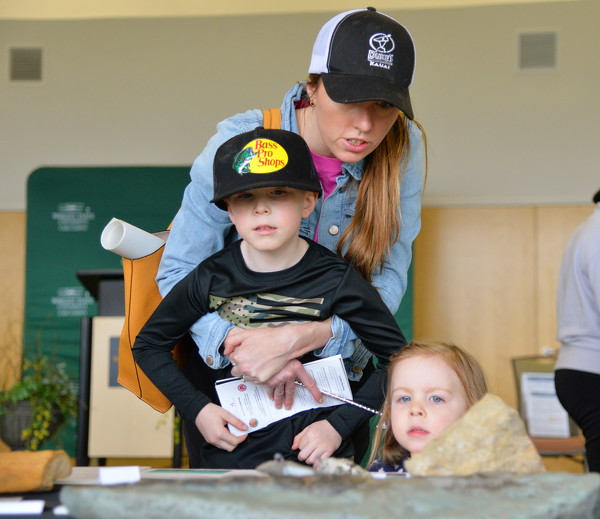
Photo by Paige Sutter/The Daily Standard
Haley Pohl, Celina, picks up her son Duke, 5, to look at fossils as Cece Pohl, 3, peers over the table during Ohio Geology Discovery Day at Wright State University-Lake Campus on Saturday afternoon.
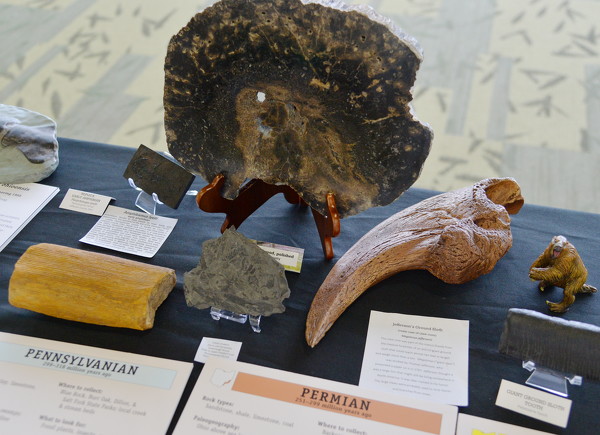
Photo by Paige Sutter/The Daily Standard
Among the fossils was a claw from a giant ground sloth at Ohio Geology Discovery Day at Wright State University-Lake Campus on Saturday afternoon.
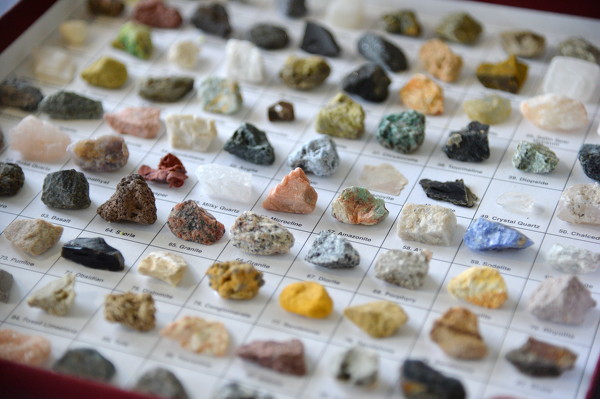
Photo by Paige Sutter/The Daily Standard
Samples of colorful rocks and minerals from Ohio sit on display at Ohio Geology Discovery Day at Wright State University-Lake Campus on Saturday afternoon.

Photo by Paige Sutter/The Daily Standard
Easton Selver, 3, Coldwater, colors over a drawing of a Dunkleosteus, an extinct genus of fish during Ohio Geology Discovery Day at Wright State University-Lake Campus on Saturday afternoon.
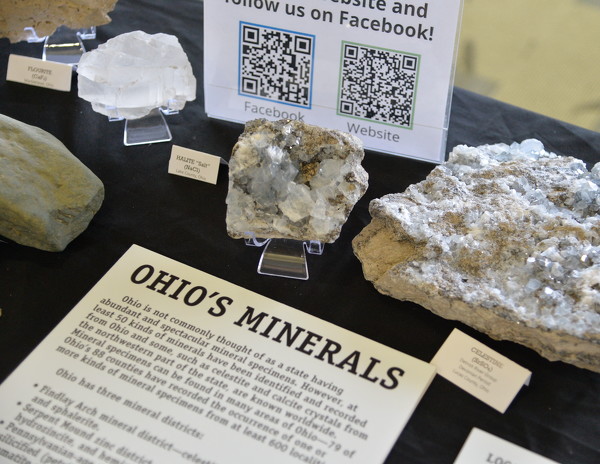
Photo by Paige Sutter/The Daily Standard
A variety of minerals found in Ohio sit on display at Ohio Geology Discovery Day at Wright State University-Lake Campus on Saturday afternoon.